Caregivers in Context: What Broadway’s CATS: The Jellicle Ball Teaches Us About Caring for LGBTQ+ Elders
Caregivers in Context: What Broadway’s CATS: The Jellicle Ball Teaches Us About Caring for LGBTQ+ Elders
By Chance Browning
COO, Caregiver Action Network
As CATS: The Jellicle Ball enters the final week of its celebrated Broadway run, audiences have one last opportunity to experience one of the most daring theatrical reinventions in recent memory. Even better for fans, the production has announced that an original cast recording is finally on its way, ensuring that this landmark interpretation will continue to resonate long after the curtain falls. It’s also worth noting the production’s recent wins at the Tony’s, including Best Direction of a Musical: Zhailon Levingston and Bill Rauch, Best Choreography: Omari Wiles and Arturo Lyons, and Best Costume Design of a Musical: Qween Jean (who made history as the first openly transgender person to win a Tony Award.)
At first glance, Andrew Lloyd Webber’s Cats might seem like an unlikely inspiration for a caregiving conversation. But CATS: The Jellicle Ball transforms the familiar musical into something profoundly human by reimagining it through the lens of Black and Latinx ballroom culture—a community built on resilience, self-expression, and chosen family.
For caregivers, especially those supporting LGBTQ+ loved ones, the production becomes something even more meaningful: a story about aging, belonging, forgiveness, and the life-changing power of community care.
Ballroom Culture: A Family Built by Choice
For those unfamiliar with ballroom culture, it emerged in New York City in the late 1960s and early 1970s through Black and Latinx LGBTQ+ communities who were often rejected by their biological families and broader society. Participants formed “houses,” led by house mothers and fathers who provided mentorship, emotional support, guidance, and often literal housing to younger LGBTQ+ people navigating discrimination, homelessness, or isolation.
The ballroom floor became more than a stage. It became a place where people could compete, celebrate one another, reinvent themselves, and, perhaps most importantly, find family.
That concept of chosen family has long been essential to LGBTQ+ life. For many older LGBTQ+ adults—particularly those who lived through decades of discrimination, the AIDS epidemic, and legal exclusion—chosen family often remains their primary caregiving network as they age.
Today, as LGBTQ+ older adults are statistically more likely to live alone, less likely to have children, and more likely to rely on friends and community members for care, ballroom culture’s emphasis on mutual support feels remarkably contemporary.
In CATS: The Jellicle Ball, every dance, every category, every embrace reminds us that caregiving isn’t limited to blood relatives. Sometimes, the people who save us are the family we build ourselves.
The Elders at the Center of the Ball
One of the production’s greatest strengths is how deeply it honors its elder characters.
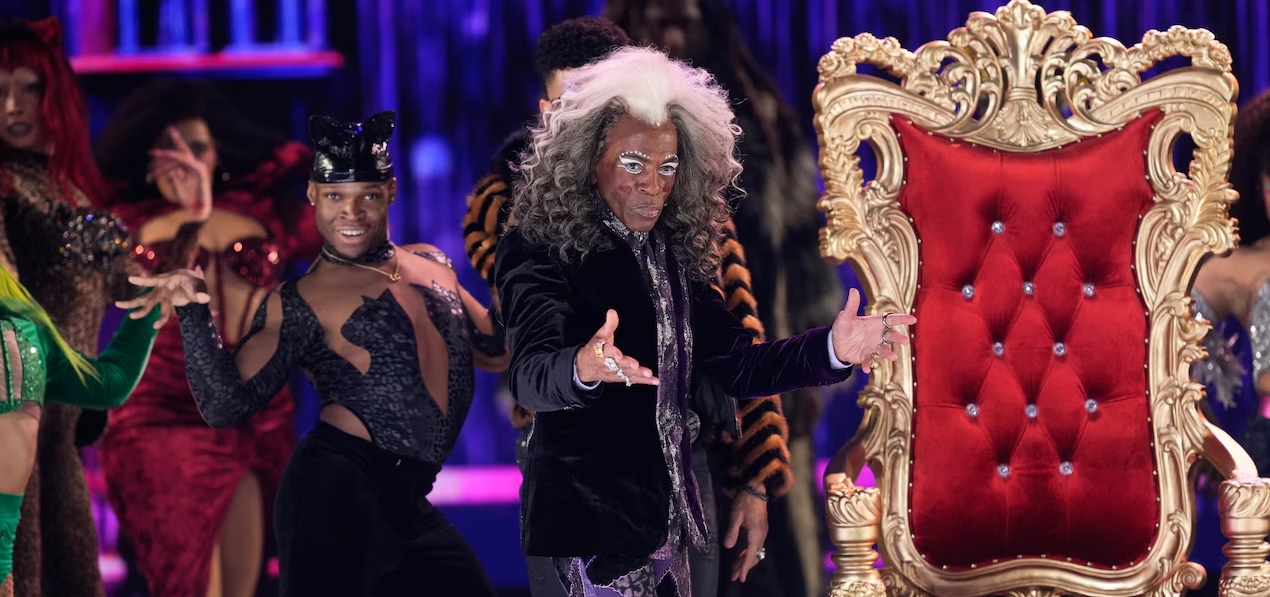
At the center stands Old Deuteronomy, portrayed with extraordinary gravitas by André De Shields.
Few performers possess a legacy equal to De Shields. A Tony Award winner, Broadway legend, and one of theater’s most influential Black artists, his decades-long career has helped redefine what longevity, artistry, and authenticity can look like. His presence alone communicates wisdom earned through survival.
Within the world of the ball, Old Deuteronomy functions less like a monarch and more like an elder statesperson—a respected community leader whose role resembles that of a house parent guiding generations that follow. His authority comes not from power, but from care, experience, and the trust of his community.
That dynamic mirrors countless LGBTQ+ communities, where older adults serve as historians, mentors, advocates, and caregivers in their own right.
Nearby is another unforgettable elder: Gus the Theatre Cat, played by ballroom icon Junior LaBeija.
For many audiences, LaBeija’s appearance carries tremendous historical significance. Widely recognized as one of ballroom culture’s most influential figures, he became internationally known through the landmark documentary Paris Is Burning, which introduced mainstream audiences to ballroom culture while preserving an essential chapter of LGBTQ+ history.
His casting is more than symbolic.
It is a passing of the torch.
When Gus reflects on memories of the stage and a lifetime of performances, LaBeija isn’t simply acting. His presence reminds audiences that entire generations of LGBTQ+ elders carry histories our communities cannot afford to lose.
Their stories are living archives.
Their survival is cultural inheritance.
Grizabella: When Community Becomes Care
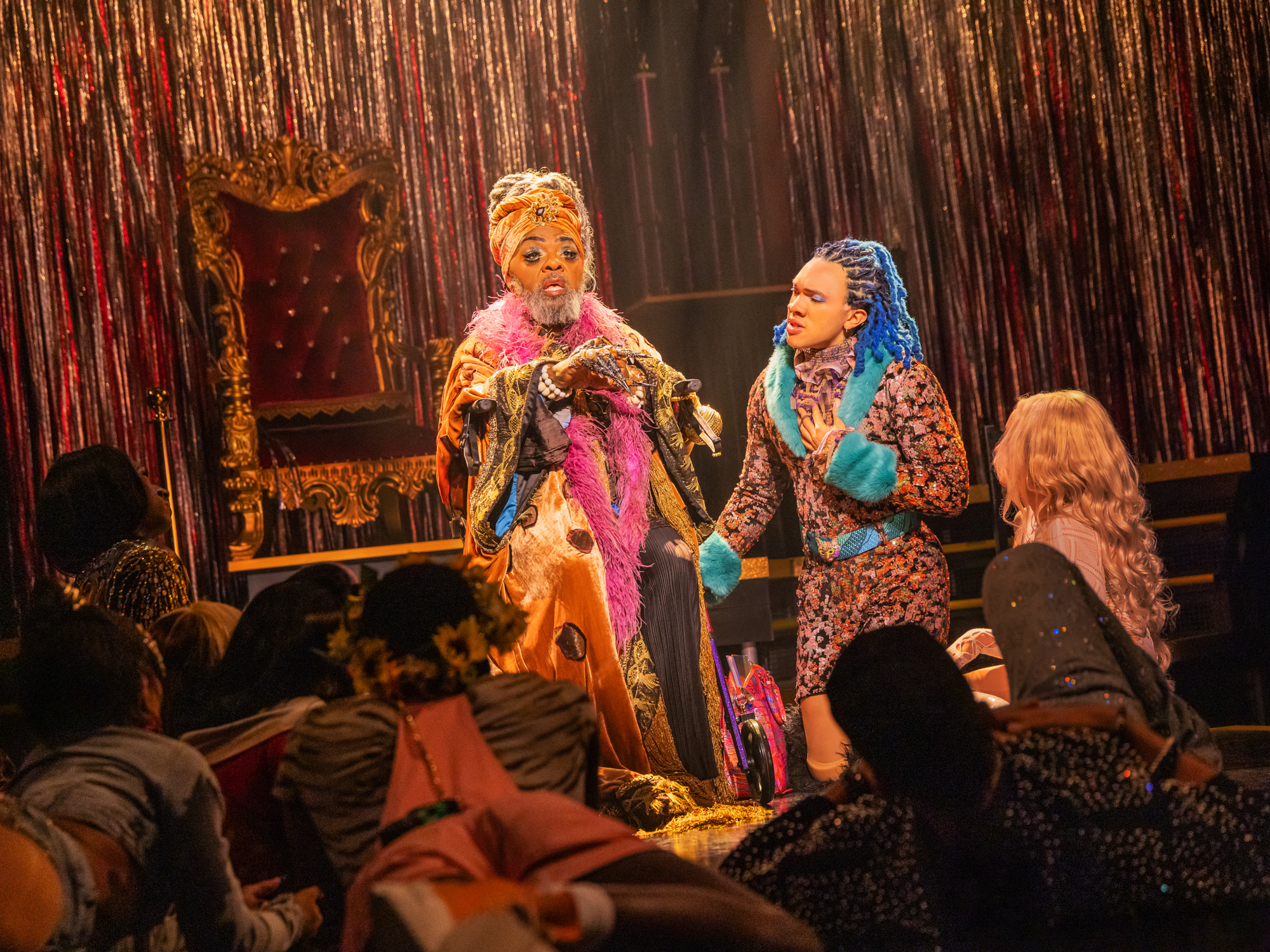
Perhaps nowhere is caregiving more emotionally visible than in this production’s interpretation of Grizabella, portrayed with remarkable vulnerability by “Tempress” Chasity Moore.
While the musical has always positioned Grizabella as an outsider longing to return, this ballroom adaptation gives her isolation striking new dimensions.
Though never explicitly stated, the production invites audiences to see someone wrestling with aging, loneliness, shame, and perhaps even recovery from substance use. She returns carrying visible emotional scars, uncertain whether the community she left—or that left her—will ever welcome her home.
For caregivers, this story feels deeply familiar.
Many older adults experience profound social isolation.
Some carry histories of addiction.
Others have survived trauma, estrangement, or decades of stigma.
Many simply fear becoming invisible.
What makes Grizabella’s journey extraordinary is that her redemption does not happen alone.
The younger members of the Jellicle community gradually shift from judgment to compassion. Rather than defining her by her past, they choose empathy over exclusion.
They make room.
They bear witness.
They remind her that she still belongs.
That is caregiving.
Not because anyone administers medication or helps with daily tasks.
But because healing often begins long before physical care.
It begins when someone says:
“You still have a place here.”
For LGBTQ+ elders—many of whom have experienced rejection from biological families—that message can be profoundly life-changing.
Care Across Generations
Throughout CATS: The Jellicle Ball, younger performers continually uplift their elders.
Old Deuteronomy is honored.
Gus is revered.
Grizabella is ultimately embraced.
These moments illustrate something caregivers know well: care flows in every direction.
Older adults offer wisdom, resilience, humor, and history.
Younger generations offer advocacy, companionship, emotional support, and practical assistance.
Healthy communities depend upon both.
In ballroom culture, these reciprocal relationships have sustained LGBTQ+ people for generations. House parents nurture young members, who later become caregivers themselves. As elders age, communities often return that care through visits, advocacy, financial support, and ensuring that their legacies endure.
This cycle of mutual care represents caregiving in one of its purest forms.
Why This Story Matters Right Now
As CATS: The Jellicle Ball concludes its historic Broadway engagement, it leaves behind something much larger than an acclaimed revival.
It offers audiences a vision of what caregiving can become.
A world where elders remain visible.
Where communities choose compassion over exclusion.
Where forgiveness is possible.
Where recovery is supported.
Where history is treasured.
Where chosen family stands beside biological family—not as a replacement, but as another powerful expression of love.
For LGBTQ+ older adults, those ideas are not merely theatrical.
They are daily realities.
As America’s population ages, caregivers increasingly serve diverse families whose support systems may look different than traditional expectations. Recognizing and honoring chosen family isn’t simply culturally competent—it is essential to providing compassionate care.
The ballroom reminds us that every community needs its elders.
And every elder deserves a community that never stops calling them home.
Caregiver Action Network Resources
The themes explored in CATS: The Jellicle Ball reflect many of the realities caregivers navigate every day. Caregiver Action Network offers trusted information, practical tools, and supportive communities that can help caregivers care for loved ones—and themselves.
Supporting Older LGBTQ+ Adults: CAN’s Community Care Corps partnership with SAGE: Advocacy & Services for LGBTQ+ Elders
Better Understand Trans Health & LGBTQ+ Aging: Access The Eden Lab, through CAN’s Partnership with Embodied Labs
National Caregiver Help Desk: By Phone, Chat, Email, or App: 855-227-3640
Building Your Care Team: Making a Care Plan
Mental Health Resources for Family Caregivers:
- Blueprint for Families of Loved Ones with Mental Health Issues
- Families, Addiction, and Mental Health Network
Preparing for Aging and Long-Term Care Planning:
- Planning for Care: Choosing the Right Long-Term Care Facility For Your Loved One
- Long-Term Care Planning for Aging Parents: What Every Family Caregiver Should Know
No caregiver should have to navigate aging, isolation, or complex care alone. Whether your family is connected by blood, marriage, friendship, or chosen bonds, compassionate support begins with recognizing that every caring relationship matters.