Caregivers in Context: The Mandalorian and Grogu
Caregivers in Context: The Mandalorian and Grogu
By Marvell Adams Jr.
Chief Executive Officer
As a lifelong Star Wars fan, I went into The Mandalorian and Grogu expecting adventure, action, and perhaps a little nostalgia.
After all, Star Wars was first introduced to me by my older brothers more than 40 years ago. It has been a constant companion through different chapters of my life, connecting generations of fans through stories of hope, courage, sacrifice, and belonging.
What I wasn’t expecting was a caregiving story.
And yet, there it was. Front and center.
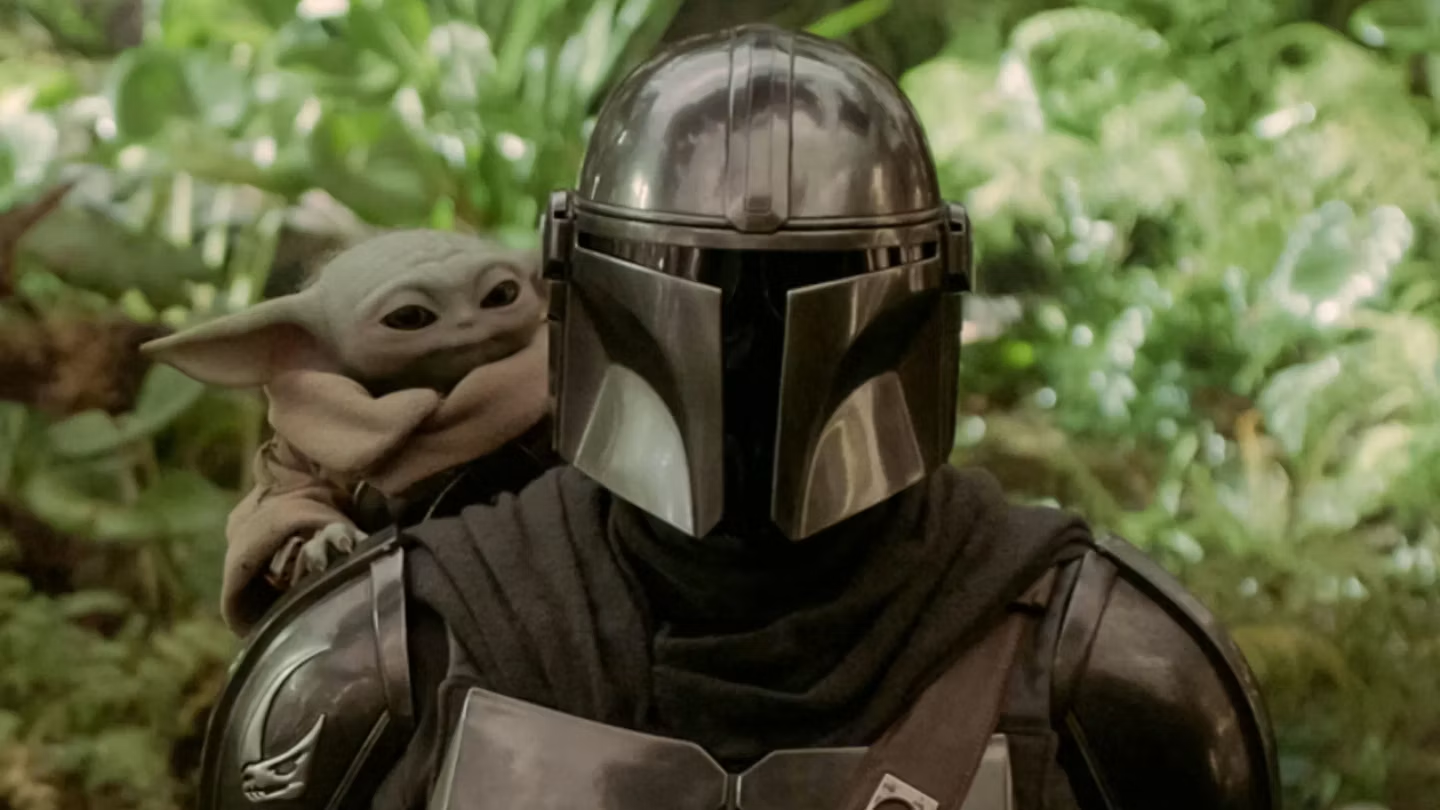
For years, audiences have followed the relationship between Din Djarin—better known as the Mandalorian—and Grogu. We have watched a hardened bounty hunter become something more: a protector, a guide, a teacher, and ultimately, a caregiver.
Like many caregivers, Mando repeatedly places himself in harm’s way to ensure the safety and well-being of someone he loves. He sacrifices comfort, certainty, and often his own safety to protect Grogu. Throughout the story, caregiving is not framed as weakness. It is framed as responsibility. As devotion. As love.
But what struck me most in this film was that caregiving was not shown as a one-way relationship.

At a pivotal moment, after once again risking everything for Grogu, Mando attempts to send him away to safety. Grogu refuses.
Instead, he returns.
He protects.
He cares.
He shows up.
“The old protect the young. The young protect the old. This is the way.” -Din Djarin, The Mandalorian
In that moment, the relationship transforms from a simple story of guardian and child into something much deeper. We see a truth that millions of caregiving families understand every day: care flows in multiple directions.
That phrase may be part of Mandalorian culture, but it also feels remarkably familiar to anyone who has experienced caregiving across generations.
Across America, grandparents help raise grandchildren. Adult children care for their aging parents. Young caregivers support siblings and family members with disabilities, chronic illness, or mental health conditions. Families create circles of care that often defy traditional definitions of who gives and who receives support.
Caregiving is rarely a straight line.
It is a relationship.
The film also beautifully highlights the unique strengths that different generations bring to one another. Mando contributes wisdom, experience, protection, and foresight. Grogu contributes curiosity, resilience, courage, and an ability to see possibilities that others overlook.
Neither succeeds alone. Together, they thrive.
That dynamic mirrors what we see throughout caregiving. The strength of youth and the wisdom of experience are not competing forces. They are complementary. Each generation has something to teach. Each generation has something to give.
Another aspect of the film that resonated deeply with me was its portrayal of a male caregiver.
Too often, caregiving is viewed through a narrow lens. While women continue to shoulder a disproportionate share of caregiving responsibilities, millions of men are also caring for spouses, partners, parents, children, friends, and chosen family members.
Many do so quietly.
Many do so without recognition.
Many do so without ever calling themselves caregivers.
Yet there on the screen was a character beloved by millions whose defining characteristic is not his strength, his combat skills, or even his heroism.
It is his care.
His willingness to show up.
His willingness to protect.
His willingness to love.
At a time when we need more people to recognize caregiving as a shared human responsibility, that representation matters.
Perhaps that is why this story landed so powerfully.
Behind the spaceships, distant planets, and epic battles is a simple truth: none of us get through life alone.
We need one another.
We depend on one another.
We care for one another.
Whether through blood family, chosen family, friendships, or community, caregiving remains one of the most profound expressions of what it means to be human.
Bravo to Jon Favreau and the creative team behind The Mandalorian and Grogu for weaving these themes into a story that is both entertaining and deeply moving.
Sometimes the most powerful caregiving stories are not the ones explicitly about caregiving.
Sometimes they’re simply stories about love, responsibility, sacrifice, and belonging.
Stories that remind us that care is not just something we do.
It’s who we are.
And, perhaps, that is the way.
Caregiver Action Network offers resources, education, and support for every stage of the caregiving journey:
- Reach out to the National Caregiver Help Desk or call 855-227-3640 for personalized guidance from caregiving experts, help finding resources, support groups, or just someone to listen.
- Family Caregiver Toolbox
- 10 Tips for Family Caregivers: Balancing Caregiving and Self-Care
- Tips for New Caregivers: What I Wish I Knew Before I Started Caregiving
- Caregiver Self-Care Checklist: Managing Stress and Support Groups
- Caregiver Doctor Visit Checklist: Effective Appointment Preparation
- Patient File Checklist for Effective Caregiver Management
- Medication Management Tips for Caregivers
- Asking for Help as a Caregiver and Building a Support Network
- Getting Help
- Care Management for Family Caregivers: Think Like a Care Manager
- Making a Care Plan