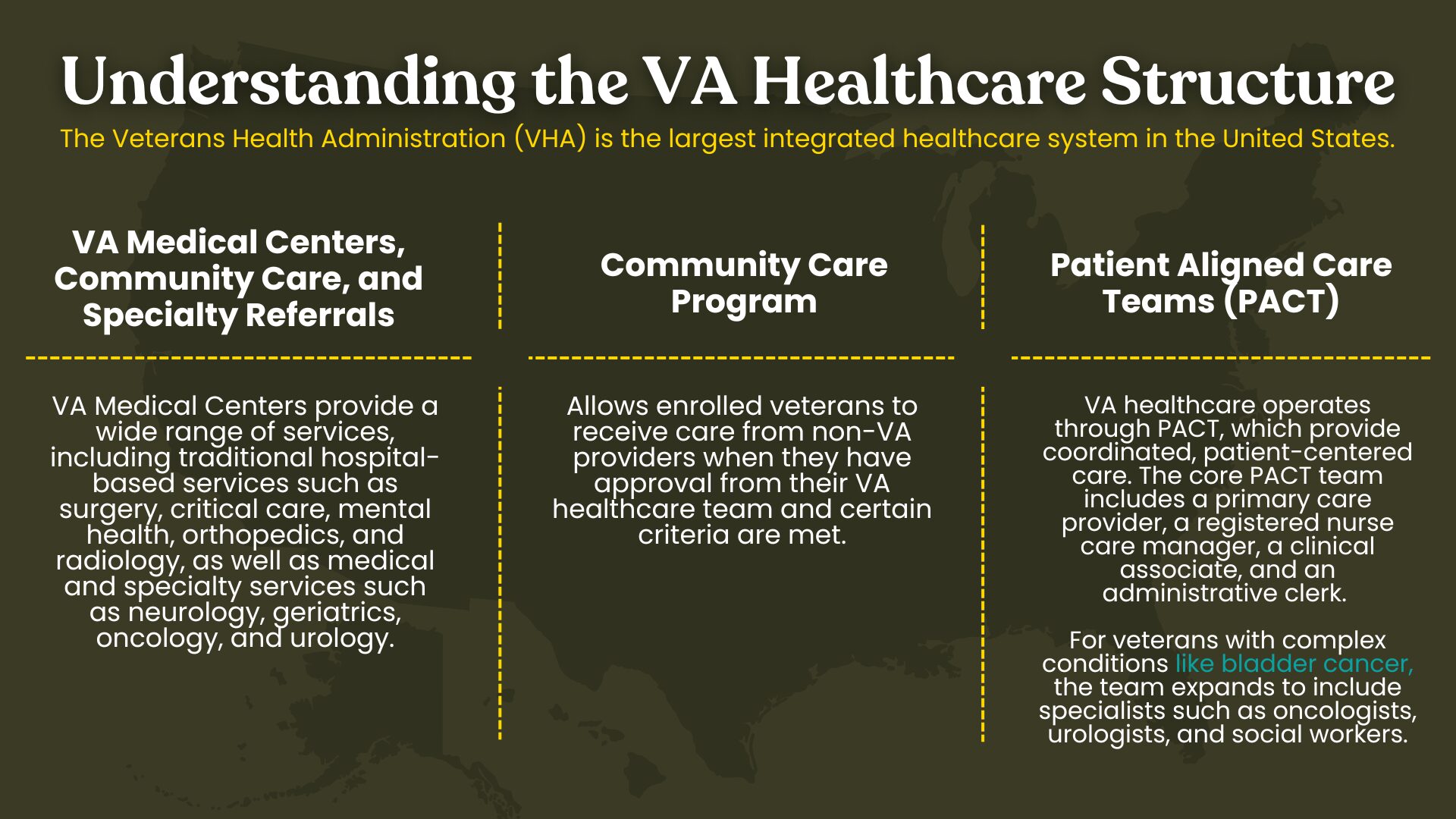
The Veterans Health Administration (VHA) is the largest integrated healthcare system in the United States. There are currently more than 9 million veterans served by the system.
Veterans enrolled in VA healthcare can receive specialty care, including oncology services for conditions like bladder cancer, either at VA facilities or through the Community Care Program when VA cannot provide timely or geographically accessible care.
VA Medical Centers, Community Care, and Specialty Referrals
VA Medical Centers provide a wide range of services, including traditional hospital-based services such as surgery, critical care, mental health, orthopedics, and radiology, as well as medical and specialty services such as neurology, geriatrics, oncology, and urology.
The Community Care Program allows enrolled veterans to receive care from non-VA providers when they have approval from their VA healthcare team and certain criteria are met: if the needed service is not available at VA, if the veteran faces excessive wait times (more than 20 days for primary care or 28 days for specialty care), or if the veteran lives more than 30 minutes from a VA facility (or 60 minutes for specialty care).
For bladder cancer patients requiring specialized oncology care, this can be particularly important when local VA facilities lack specific expertise.
Who does what: providers, care teams, and case managers
VA healthcare operates through Patient Aligned Care Teams (PACT), which provide coordinated, patient-centered care. The core PACT team includes a primary care provider (physician, nurse practitioner, or physician assistant), a registered nurse care manager, a clinical associate (licensed practical nurse or medical assistant), and an administrative clerk. For veterans with complex conditions like bladder cancer, the team expands to include specialists such as oncologists, urologists, and social workers.
Case managers and social workers play critical roles in coordinating care across multiple providers and helping caregivers navigate the system. The VA Caregiver Support Coordinator at each facility serves as a key contact for family caregivers, connecting them with resources and support programs.
Hear from Gerald, who struggled to get his appointments approved.
Me diagnosticaron cáncer de vejiga en 2023 y, cuando presenté la solicitud, me la aprobaron de inmediato; creo que eso se debió en gran parte a la Ley PAC, que ayuda a los veteranos. Pero la dificultad que tengo con el Departamento de Asuntos de Veteranos (VA), en lo que respecta a las citas, es que en realidad acudo a Urology of Virginia y a Virginia Beach. Quería utilizar mis prestaciones por discapacidad del VA, pero mi enfermera y el personal de finanzas de Urology of Virginia no me lo recomendaron. Me dijeron que, como hay tantas lagunas legales que hay que sortear para recibir el tratamiento, para cuando se pudiera tratar, mi estado habría empeorado. Me dijo: «Te recomiendo encarecidamente que utilices tu TRICARE, que solo tiene un copago de 30 dólares, pero normalmente aprueban el tratamiento de inmediato». Sin embargo, me dijo que, con el Departamento de Asuntos de Veteranos (VA), aunque lo pagarán, muchos pacientes tienen que esperar mucho tiempo antes de recibir el diagnóstico. Con el TRICARE, se aprueba de inmediato.